Quantcast

PIVOTE – open source learning for virtual worlds

British firm Daden have been releasing virtual worlds products for a while now – we covered their in-world web browser last July. Their latest launch is an “open-source learning system or virtual worlds, the web and iPhone”. Its moniker is PIVOTE and it’s the result of a project called PREVIEW funded by the UK Government’s Joint Information Systems Committee (JISC). The project’s focus was problem-based learning in virtual worlds, and PIVOTE is the end-result. Paramedic training for St George’s, University of London was the initial focus that’s led to final product.

stgeorges-paramedic-500px

Essentially, Pivote is a web-based learning management system where detailed exercises can be formulated as fairly standard, text-driven scenarios with decision pathways, or as avatar driven exercises in Second Life or OpenSim (Daden states its platform can easily be adapted to other virtual worlds). The text-based options can also be utilised in-world via what is presumably Daden’s in-world browser. St George’s have a sim in Second Life (click here to see for yourself) that is publicly accessible.

St George’s Senior Lecturer in Paramedic Science, Alan Rice said “This programme provides the students with a fun learning environment, where they can afford to make mistakes online, which they could not afford to make in the real world. When they make a mistake online, they are always keen not to make the same mistake again.” A paramedic student at St George’s, Fiona Cropp, was happy with the virtual training process – “It’s a really useful tool. It’s much better to be able to actually perform treatments rather than just talk about it. Everyone is online at the same time so you can bounce ideas off each other and make an informed decision. I had never used Second Life before, but I found it really easy to get on with.”

A useful overview of the paramedic training scenario can be viewed here:

Pivote isn’t the first integrated training solution using virtual worlds, but it’s certainly progressed things considerably. The challenge for any platform is convincing key management that scarce health dollars should be sunk into virtual worlds-based training. Health professionals and academics are perfectly positioned to demonstrate just that, and there’s no shortage of evidence of the cost benefits of effectively trained clinicians. Anything that increases the confidence of new practitioners in the breadth of the clinical decision-making in a cost-effective way, will surely gain some traction in what is usually a very conservative space.

Anyone wanting to install PIVOTE for themselves can do so for free by installing it on their own servers or paying Daden to host it for them. The full instructions can be found by browsing the ‘Getting Started’ section of the PIVOTE website.

Popularity: 6% [?]

OpenSim / realXtend: fast evolution

realxtend-mar09

realXtend

realXtend has remained on a fairly fast-paced development course in recent months, with some interesting announcements in the last few days:

- the current cross-platform viewer has had an upgrade
- a brand new viewer is underway, but not expected to be released until a fair way later in the year
- a new community-driven forum for realXtend is now live
- the realXtend Wiki is set to be expanded in coming weeks

OpenSim

One of OpenSim’s touted strengths is its abilities to run alternate protocols for Client to Server communication at the same time. The Metaverse Exchange Protocol (MXP) is the latest one to come on board. This actually has some big implications for OpenSim and its positioning as a competitor to Second Life. MXP and the related Open Metaverse Structured Data (OMSD) allow for the integration of input devices for real-time recording of gestures.

In clearer terms, that means that any OpenSim user in the future will have the ability to create custom gesturing and “bone driven facial expressions”. That’s an enormous step ahead of the current state of play in Second Life. Of course, it’s all theoretical at this stage but the OpenSim team are stating “they are currently in process of adopting” MXP.

What’s it all mean?

For the non-developer, the above information is a long-winded way of saying that OpenSim is continuing its momentum at a cracking pace. There’s some features on the way in the medium term that will provide some marked differentiation from Second Life – on the brave assumption that Linden Lab aren’t working on something similar themselves.

Popularity: 4% [?]

eKidna World: Australia’s preteen virtual world challenger

eK-logo-color-textonly eKidna World is one of the newest virtual world offerings on the block for preteens, and it’s an Australia-based one to boot.

Founded by Brisbane-based mother of two, Karen Orford, eKidna World is a web-based world with a fairly hefty feature-set. As you’ll read in our interview below, eKidna is essentially a one-person self-funded operation, which makes the end result even more impressive.

A brief review

Registration is fairly easy, with a parent needing to provide key information prior to registering their child’s account. One of eKidna’s features is Mate Safety™ – if this is selected by the parent on registration, every friend (mate) request will require the parent to enter their password before that connection is made. There’s also two chat options – Open Chat (the child can type their own phrases) of Safe Chat (selection from a catalog of phrases only).

Once a child has logged in, they can choose their avatar from a range of Australian animals like kangaroos, emus and possums. On entering the world itself, it has an immediately familiar interface. Movement occurs via mouse clicks, there’s a chat window, a ‘Mate’ tab, a map of the world, private messaging and an inventory of goods purchased. The basic services is free but the premium option gives much more flexibility around avatar customisation, gaining awards, saving high scores from games and owning a house. It costs $7.95 Australian per month with multi-month discounts.

ekidna1

As far as the activities themselves, I found them quite varied. The areas themselves are really well rendered with lots of endearing landscapes and characters. Each area features at least one activity e.g. kangaroo races or snowball throwing. Each requires more than one person to take part before commencing, which encourages interaction but which can also be frustrating at present as a new service with small numbers of registrations.

Overall, eKidna is a very worthy challenger in the burgeoning preteen virtual world market. Australian customers will enjoy its familiarity and others will engage with the (sometimes stereotypical) Australian flavour.

Interview

Lowell Cremorne: What specifically led you to decide to create eKidna?

Karen Orford: At 7 and 9 my daughters had finally reached the age that they wanted to explore the internet and so with some trepidation I ventured out to find some things for them to do online that I considered appropriate for their age. But it soon became obvious that matching their computer skills, which like most children of their generation are quite advanced, with their social and emotional development, was not easy. My personal standards of what is appropriate I think would be considered quite high. We are one of those homes in which TV is restricted and if watched, is monitored. I didn’t like sites with advertising; I didn’t like sites with violence, or links. I also found that none of the kid’s sites had done anything in particular to allow the parents an element of control over with whom their kids chatted with.

Finally I came to the conclusion that if I wanted a site which met all of my personal criteria I was going to have to create it myself! I then set out to search for a theme and was surprised to find that there was nothing quintessentially Australian which I couldn’t believe considering our diverse range of unique animals and landscape. At first I worried whether Australian children would be interested in Australian animals, but I got the shock of my life to discover in my focus groups, and I’m not sure it is the right term, that they are fiercely patriotic about their Aussie animals. Of course the international fascination with Australian animals is well established so that sealed it for the theme and the ideology, and so eKidna was born.

ekidna2

Lowell Cremorne: What professional background do you come from?

Karen Orford: I have a Communications Degree from the University of Canberra which in a strictly professional sense I’ve barely used! I have spent most of my life self-employed from managing English schools for children in Japan, to running several different businesses with my husband. eKidna, however, is an opportunity for me to go it alone.

Lowell Cremorne: Roughly how many registrations have occurred to date or are you hoping will occur?

Karen Orford: Two weeks ago we very quietly uploaded and set about putting ekidna through its final paces before we really faced the world. Starting with my own two daughters, and while flying under the radar, it has grown to about 45 registrations as word has spread quietly amongst their friends at school. We are now ready to take on the world and the big push for registrations begins.

Lowell Cremorne: Is eKidna self-funded or if not, who underpins it financially?

Karen Orford: eKidna is completely self funded. I have literally remortgaged the house on this one and I am astounded and proud of what we have managed to create on our budget. If I’d realised at the beginning what the big boys, with venture capital, were spending on start up virtual worlds I would never have attempted what I did because I would have thought it was unachievable for a
mum from Brisbane. The only thing underpinning eKidna is me!

Lowell Cremorne: Is eKidna staffed fulltime in regards to moderation etc?

Karen Orford: Yes it is.

Lowell Cremorne: What future growth plans do you have?

Karen Orford: I have been self employed most of my life so ekidnaworld.com has a very clear and realistic business strategy and growth plan. The plan is conservative and growth projections are based on just 1% of the reported growth achieved by known competitors such as Club Penguin and Webkinz World. Our first target is the English speaking market ie Australia, the US and the
UK. After that we may well expand into different languages. The Australian theme and the cost effective opportunity to practice English would go over very well with children in Japan. It is a market I know well.

Lowell Cremorne: You mentioned in your press release that you’re taking on Disney – who do you see as your primary competitors?

karen_orford Karen Orford: It is interesting in that despite the mass far reaching tentacles of the internet the competitors still vary widely from country to country. Club Penguin is the clearly the king of the jungle here in Australia, but in the US it has very serious competition from the likes of Webkinz World, and in the UK European sites such as Habbo have a major grip. However, despite these sites being competitors in that they are online children’s virtual worlds none of them have focused on chat safety in the way ekidnaworld.com
has. In that sense we have no competitors. Our Safety Feature, Mate Safety, is truly unique. You will find a full description of Mate Safety and how it works in the Parents’ Info section of ekidnaworld.com.

Lowell Cremorne:A big players in the Australian field is Club Penguin – do you think you’ll need to attract some of their user base to be successful?

Karen Orford: I don’t think we will need to attract some of Club Penguins user base because despite the number of virtual worlds for children growing rapidly in the last couple of years it is still relatively a new niche of the internet. My research leads me to believe that our largest competitor Club Penguin, still only holds around 2.5% of the potential market, leaving plenty of room for new entrants such as ekidnaworld.com. Particularly when we have differentiated ourselves with a unique feature such as Mate Safety. Having said that, I think we can still expect to claim at least some of their user base due to the human nature of children simply looking for ‘what’s next?’.

Popularity: 5% [?]

Video review of Metaplace

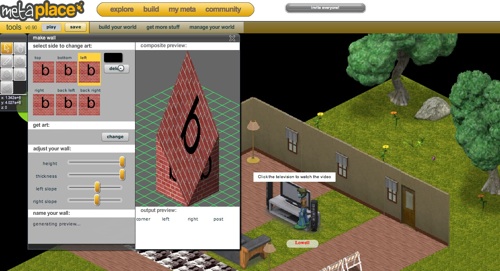
The MP Insider blog has a video review of a particular gaming area in Metaplace – Zoo Escape!. For those who haven’t seen Metaplace in action, it’s a useful heads-up on its form factor and its content creation options:

As stated previously, being web-based and having good content creation opportunities should prove an enticing package.

Popularity: 4% [?]

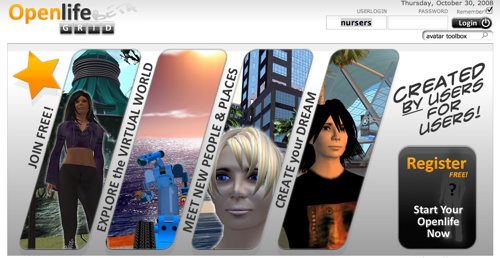
Openlife dumps Second Life viewer support

I haven’t logged into Openlife for a few weeks, so I was unaware that support for the standard Second Life viewer has ceased. The proprietary viewer is now standard fare.

openlife_feb2008

Release 1.6.2 is the current build, and the Mac version runs like a dream for me. I’d argue its performance is zippier than the Second Life browser though it’s not without its own ability to crash. The Openlife web portal has also had some welcome further improvements.

As stated previously, this is a grid with momentum.

Popularity: 4% [?]

Openlife currency on the way

In another evolutionary move for Second Life alternative OpenLife, a virtual currency is on the way for the platform. February 2009 is the tentative timeline, and any Openlife resident can purchase what will be called ‘credits’ via PayPal or credit card. Only region land owners will be able to cash out credits which may concern some, but it’ll also be interesting to see what impact this has on the Openlife economy.

openlife-currency

Arguably, region owners will be more set up to declare virtual earnings in an environment of greater scrutiny from tax officials. The availability of the currency itself should also see a boom in Openlife businesses selling virtual goods which in turn drives growth in the platform. Momentum is key for any development and Openlife at this stage have certainly maintained that.

Thanks to CyberTech News for the heads-up

Popularity: 4% [?]

Another perspective on Twinity

Australian machinima producer and virtual worlds observer, Skribe Forti, has created a very interesting review of mirror world Twinity. It seems a balanced piece that covers both the strengths and weaknesses of Twinity, which is currently in beta:

What are your thoughts? Do you agree with Skribe’s summary of Twinity?

Popularity: 3% [?]