Quantcast

Mayo Clinic in Second Life

Looks like an interesting session of the non-profit commons in SL this Friday:


This Friday, September 14th, Nonprofit Commons is happy to feature Brian Kaihoi (Svea Morane in SL), of the Mayo Clinic. The Mayo Clinic has had a presence in Second Life since January 1, 2009, which has grown now to 4 regions. They have been working to provide consumer health information, patient care services, internal work team support, and even modeling physical spaces inside SL before they build the buildings. Most significantly, they have found many partners in SL who share similar goals and values, that can work with the Mayo Clinic to have a larger impact on patient care. This presentation will report on Mayo Clinic’s virtual world activities in the areas of patient care, research, education and administrative services.

Brian Kaihoi has been with Mayo Clinic for 35 years. During that time he has held a variety of administrative and operational positions. As a member of the consulting staff of Mayo Clinic, Brian has worked with the Mayo Medical School and Mayo School of Continuing Medical Education on content development and delivery strategies. Currently, Brian is the Mayo Foundation Web Administrator, working with all Mayo Clinic Web activities, and works with the Center for Innovation, which is finding ways to transform the way health care is experienced and delivered.

Follow him on twitter at @bkaihoi

About the Mayo Clinic:

Mayo Clinic:  Mayo Clinic is a nonprofit worldwide leader in medical care, research and education for people from all walks of life. Doctors from every medical specialty work together to care for patients, joined by common systems and a philosophy of “the needs of the patient come first.” Mayo Clinic is governed by a 33-member Board of Trustees.  Every year, more than a million people from all 50 states and nearly 150 countries come to Mayo Clinic for care.
www.mayoclinic.orgJoin us in Second Life!

Nonprofit Commons Weekly Meeting
Friday, September 14th, 8:30 AM SLT / PST
Plush Nonprofit Commons Amphitheater
http://slurl.com/secondlife/Plush%20Nonprofit%20Commons/88/126/26

AGENDA

• 8:30 am Introductions
• 8:40 am TechSoup Announcements
• 8:45 am Mentors Central
• 8:55 am Main Speaker: Brian Kaihoi (Svea Morane)
• 9:30 am Open Mic / Announcements

http://nonprofitcommons.org

The mission of the Nonprofit Commons in Second Life is to create a community for nonprofits to explore and learn about virtual worlds, foster connections, and discover the many ways in which nonprofits might utilize the unique environment of Second Life to achieve their missions.

ReactionGrid retreats from OpenSim

Hypergrid Business has an interesting piece on the change in direction for ReactionGrid. We’ve followed them closely over the years (including our distinctly retro interview with CEO Kyle Gomboy back in 2009 and our Jibe walkthrough from earlier this year).

The changes aren’t a great surprise and funnily enough reflect my own thinking for my own studies where I’m pretty firmly in the Unity3D camp for what I need to achieve.

Here’s a snippet of what ReactionGrid have had to say:

Florida-based ReactionGrid, a pioneer in OpenSim hosting for corporations and educators, is scaling back on its OpenSim business in favor of its Unity-based Jibe platform, and considering closing down its namesake grid.

“We will focus on very high level OpenSim work only,” ReactionGrid co-founder and CEO Kyle Gomboy told Hypergrid Business.

However, the company will continue to provide hosting for JokaydiaGrid, which is focused on serving educators.

“We are pushing educators to Jokaydia,” Gomboy said.

Meanwhile. the company’s view of its namesake grid is “evolving,” he added, and the grid might even be closed.

“We’re debating that now,” he said. “I’d like to keep it up as a portal of sorts for a bit but we’ll be deciding that soon. The push is to promote Jokaydia Grid as our choice for educators which is who primarily use ReactionGrid the world.”

ReactionGrid was one of the first companies to offer OpenSim hosting, with brand-name customers like Microsoft.

You can read the full article from Maria at Hypergrid Business here.

As mentioned, it’s no great surprise but definitely an end of an area.

What’s your take on things?

The future of the Metaverse: If there has been a failure, it is ours

A great piece from www.botgirl.com on Linden Lab’s recent moves:

Fleep Tuque posted a fascinating essay yesterday with the provocative title, “Why Anyone Who Cares About the Metaverse Needs to Move Beyond Second Life; Now, Not Later.” It was a lucid and heartfelt account of Linden Lab’s transition from an ideal-driven group of Metaverse enthusists, to a market-driven corporation going after the gaming market. She also did a great job describing the impact that the corporate changes had on the Second Life community, of which she has been a long-term leader.


I was one of the Metaverse idealists she described so well. I thought that there would eventually be a seamless integration between Second Life and OpenSim that would eventually be extended to other platforms via open standards. I also believed that virtual worlds would soon move into the mainstream and be commonly used in people’s business and personal lives. I was wrong.


Linden Lab is now actively working to distance Second Life from OpenSim. One of the leading OpenSim grids recently announced that they’re abandoning the platform to focus on its own Unity-based product. Although there seems to be some growth in hypergrid compatible OpenSim participation, proprietary 3D chat room and social gaming platforms like IMVU to have a lot more momentum.


Unlike Fleep, I’m not convinced that Linden Lab is the main cause of the virtual world’s failure to actualize our idealistic vision. Sure, they would have been more successful if they hadn’t wasted so much time and resources on their ill-conceived forays into chasing the corporate market; if they had communicated well and reached out positively to the Second Life community over the years; if they had not pulled the rug out from under us so many times, such as the OpenSpace fiasco and the elimination of educational discounts. But even if they had done everything right, I don’t think the Metaverse ideal would have been embraced now outside of the current small niche.

Project to Improve Graphics Rendering in Second Life

Via Linden Lab


One of the challenges that virtual world creators face is the trade-off between rich visual detail and geometric complexity. Ideally, by adding more and smaller faces to an object, a designer can model different surface textures and create realistic variations in the interplay of light and shadow. However, adding faces also quickly increases the size of the model and its rendering cost. Normal and Specular Maps are ways to address this by allowing for the appearance of a complex surface without actually modeling fine scale geometry.

A Normal Map is an image where the color codes indicate how the renderer should reflect light from each pixel on a surface by modifying the direction that the pixel “faces” (imagine that each pixel could be turned on tiny pivots). This means that pixels on a simple surface can be rendered so that they appear to have much more detail than the actual geometry and at much lower rendering cost. Light and shadow are rendered as though the surface had depth and physical texture, simulating roughness, bumps, and even edges and additional faces.

Similarly, a Specular Map allows each pixel to have its own degree of reflectivity, so that some parts of a single face reflect sharply, while adjacent pixels can be dull.


The open source developers of the Exodus Viewer are contributing Viewer support for Normal and Specular Maps, as well as some additional controls for how light reflects from faces. Linden Lab is developing the server side support so that this powerful tool will be available in Second Life.


Design and development are under way. Watch this blog and the Snowstorm Viewers page for information on when test Viewers with these new capabilities become available.


For additional information, or to learn more about how you can participate in the open source program, please contact Oz@lindenlab.com.

ABC Island to Close in Second Life

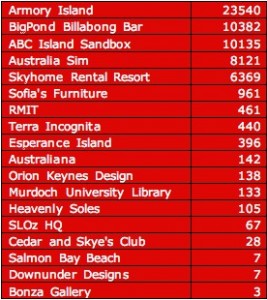
It’s not surprising but sad all the same: the wonderful community-driven project that is ABC Island in Second Life, is to close on the 22nd of September.

The island has been a staple of the Australian Second Life scene since March 2007, and it’s undergone a number of iterations since then (check out a lot of them here).

Given the relatively small number of Australian visitors the sim gets compared to its heyday, it’s not a shock that the ABC are redirecting the funds. That doesn’t make it any easier for the small and dedicated bunch of volunteer admins of the sim.

We’ll have more details on farewell arrangements / spontaneous wakes etc as we find out ourselves.

The Secret World: A Review


FunCom’s new MMORPG The Secret World is a universe full of magic, deception, and darkness. You play as a member of one of three secret societies – the Illuminati, the Templars, or the Dragon. Regardless of which society you choose, you’re probably still the bad guy, sent all over the world to guard your secrets and fight rival factions. A lot of the time, you won’t even know why you go where you do – you’re not the boss.

But it’s not a different world to the one we live in. Not really. Instead, it’s an underground version of the modern world. Granted, the real world is probably not infested with monsters, but in The Secret World, parts of it are. Those parts have been cut off from the rest of the world, their infections and invasions covered up by governments. You roam these areas, supporting your society and trying to help people along the way.

Because the game is based in reality, The Secret World is low fantasy. There’s a little bit of magic, but most of the weapons are guns, swords and hammers. Buildings and environments are modern, and there are no elves or orcs to be seen. It’s a refreshing change, and something entirely new in the MMO space.


See on www.stuff.co.nz

Machinima Expo 2012: submissions open

Pooky Amsterdam has tapped me about this, and I’m happy to slip-in this post for her.


This year marks the 5th annual Machinima Expo, a three day virtual machinima festival which bridges Second Life and the real world. The Expo will be held over the weekend of the 17th-18th November 2012, and submissions are now open for those wishing to participate.


There is no maximum running time for entries to the event, but a couple of rules must be adhered to:


Entries must comprise at least 50% machinima


Entrants must not have previously submitted the film to the Expo.


Note that films do not have to be filmed in Second Life (or any other virtual world – although entries created in any virtual world are obviously welcome), just so long as they are at least 50% machinima.


The closing date for submissions is September 30th 2012, and you can find the entry form on the Expo website.
See on modemworld.wordpress.com