Quantcast

Avatars and body image: further research participants needed

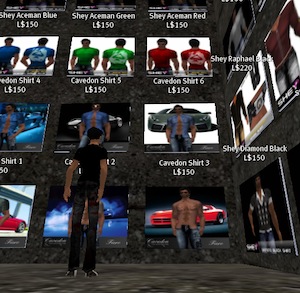
A little over a year ago we reported on a research study underway into the link between avatars and body image. That research has been continuing ever since and the initial results were inconclusive. PhD student Jon-Paul Cacioli wants to delve a little deeper on a few things, so there’s a follow-up survey for any male over the age of 18 who has an avatar in a virtual world.

It doesn’t matter if it’s Second Life, World of Warcraft or an OpenSim grid, you can take part. The survey itself will take 15-20 minutes to complete, but all respondents go into a draw for Amazon vouchers.

To take part, here’s where to go.

Popularity: 1% [?]

Between Worlds: a Second Life machinima

This post originally appeared over at our sister site, Metaverse Health

There’s not a lot to add to the great description provided by the creators:

“Between Worlds: A Journey of Hope” is a machinima produced by Panacea Luminos of NY HealthScape (USA) filmed and edited by Aliceinthenet (UK) and written by Skylar Smythe (Canada).  The inspirational piece is a story of cancer survival and accessing health information, supports and friendship in the virtual world of Second Life.   We invite you to visit: http://tinyurl.com/3esr334 to view the film and encourage your feedback and comments.

There’s four parts, which you can see below:

Popularity: 1% [?]

Virtual International Day of the Midwife

This post appeared earlier in the week over at Metaverse Health.

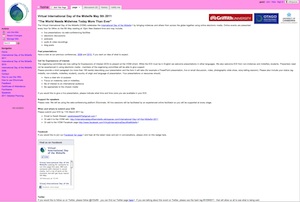
A collaboration between Griffith University (Australia), Otago Polytechnic (New Zealand) and the University of Canberra (Australia), the Virtual International Day of the Midwife is in its third year (2009 and 2010 proceedings links).

For more information or to express interest in presenting, check out the VIDM Wiki.

The call for expressions of interest is as follows:

*Call for Expressions of Interest*
The organising committee are now calling for Expressions of Interest (EOI)
to present at the VIDM eVent. While the EOI must be in English we welcome
presentations in other languages. We also welcome EOI from non-midwives and
midwifery students. Presenters need not be experienced in using electronic
media – members of the organising committee will be able to give support.
Please provide a short paragraph (no more than 150 words) describing your
presentation and the form it will take (for example a PowerPoint
presentation, live or email discussion, video, photographic slide show,
story-telling session). Please also include your status (eg midwife,
non-midwife, midwifery student), country of origin and language of
presentation. Your presentations or resources should;

– Have a clear aim or purpose
– Focus on maternity care or midwifery
– Be of interest to an international audience
– Be appropriate to the chosen media

If you would like to give a live presentation, please indicate what time and
time zone you are available in your EOI.

*Support for speakers*
Please note: We will be using the web-conferencing platform Elluminate. All
live sessions will be facilitated by an experienced online facilitator so
you will be supported at every stage.

*When and where to submit your EOI*
Please submit your EOI by 11th March 2011 by;

– Email to Sarah Stewart:
sarahstewart07(at)gmail.com
– Or add it to the VIDM wiki

– Or add to the VIDM Facebook page

Popularity: 1% [?]

3D texture breakthrough

This article appeared earlier in the week over at our sister-site, Metaverse Health

A story over at New Scientist caught my eye today. It describes a new approach to developing textured 3D objects that provides much greater realism for relatively less work, particularly for amateur content creators:

The potential of this in clinical simulation is fairly obvious. Whether it be surgery or anatomical exploration, expect to see some of those expected evolutionary improvements in quality just a little bit sooner. Developments like this also illustrate the importance of graphical accuracy in simulation – the more easy it becomes to manipulate objects in a realistic way, the better the outcomes garnered.

Popularity: 1% [?]

3D and kids: we just don’t know

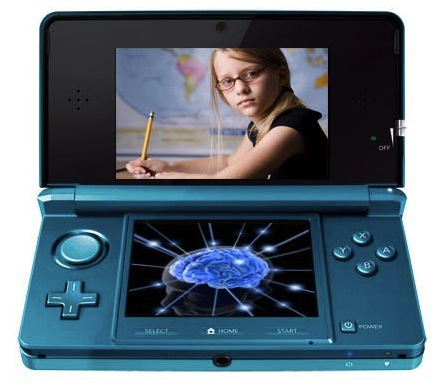
One of the more interesting issues over the past year has been around 3D at consumer level. Whether it’s 3D TVs or handheld 3D gaming, there’s a significantly ramped up debate on potential issues around the technologies. An example is this story covering Nintendo’s warning on excessive use of its 3DS handheld gaming device. The company has rightly been transparent, even if only to cover future potential legal liabilities, in its desire to frame the level of use of such devices.

There’s exactly one fact in the debate over the impact of 3D on kids and their development: we do not know in any way, shape or form what that impact is. An educated guess would be that excessive use could have a harmful impact and that in well-structured settings some use of 3D environments could actually be beneficial. However, until there’s a solid body of evidence supporting either of those claims, everything else is theorising or spin. That is likely to be the case for a number of years yet, as building the research body on top of the great work to date is a huge task. It’s an even bigger task given the tendency for most 3D environments to be closed shops owned by large companies like Nintendo, Sony and Microsoft.

In the meantime expect lots of hype and probably an equivalent amount of hysteria. For those interested in the area, an interview I conducted with Andrew Campbell from the University of Sydney’s Prometheus Research team eighteen months ago is still very pertinent in addressing the complexities of the area.

I’d be really interested to hear your thoughts on the likely impacts, both positive and negative, of the seeming diffusion of 3D devices in the home.

Popularity: 1% [?]

Microsoft Kinect on WoW: evolutionary steps

This post comes from Metaverse Health, our sister site devoted to everything related to health and virtual worlds.

Here’s a great video showing the use of the Kinect to play World of Warcraft using a software framework called FAAST. After the initial demo there’s some useful discussion by the University of Southern California’s Institute for Creative Technologies on its potential applications.

Those applications are something discussed here regularly: rehabilitation and physical activity. Imagine the impact of the technology shown in the video for someone who plays a dozen or more hours of an MMO each week? Let alone someone with a chronic disease or multiple lifestyle risk factors.

Anyway, have a look for yourself:

For my interest in clinical simulation, these developments are of particular interest. Truly effective simulation is likely when health practitioners are physically able to replicate tasks. With my crystal ball in hand, I can’t see that being any more than five years away.

Popularity: 1% [?]

AIDS Quilt in Second Life

This story originally appeared on our sister site, Metaverse Health.

I’ve gone on ad nauseam about the benefits of virtual environments in regard to communal support around health issues. In the physical world, one of the most powerful support campaigns of the past 25 years is the AIDS quilt. Thanks to a joint initiative between Startled Cat and Jokaydia, that sucess story has moved into the virtual worlds of Second Life and Jokaydia’s OpenSim grid.

The premise is simple but powerful: ask those who have lost loved-ones to HIV/AIDS to commemorate those lost in a 3D version of a quilt. Like most of these things, you need to see it for yourself to get the power of it, but once you do it becomes obvious. I had a wander around the handful of quilt rooms already created and was impressed to saythe least – the overall build in Second Life is stupendous and easy to get around / navigate.

The launch of the 3D AIDS quilt occurred today and the call is now out for people to contribute.

For more information, go to either the website or check it out for yourself in Second Life.

Popularity: 1% [?]