Quantcast

10 days left to save humanity

Superstruct game.

Superstruct runs for only 10 more days.

Due to the nature of the game, it’s still not too late to join in, though some may find the task even more daunting than when the game began. Superstruct is difficult to navigate. Though several superstructs have been put together for this express purpose, there is no single, compact point from which to view the game, no easy and comprehensive way to search the collection. Additionally, there’s either quite a bit of duplication of effort, or people have not been sufficiently able to explain how their superstruct differs from other very similar efforts – this makes researching the results doubly difficult.

6452 players. 488 superstructures. Sounds good, considering the nature of the game.

Score: 8196. Current Survival Horizon: 2051. Ouch. Looks like we haven’t significantly impacted our survival horizon. Still, 10 days to go!

Here’s a random selection of superstructures, intended to give an overview of the types of superstructures that have been created thus far.

The Common Purpose Engine

“Large-scale problems do not require large-scale solutions. They require small-scale solutions within a large-scale framework.”

This superstruct is working to reduce carbon emissions from energy production while still keeping everyone fed and keeping necessary technologies running. An open-source online carbon/energy monitoring system is being combined with national systems of Tradable Energy Quotas (see www.teqs.net).  Energy usage by homes and businesses will be closely monitored to ensure that a minimum of energy is being used to reduce carbon emissions.

Badge Winner! Longbroading
The Rooftop Cultivation Association
“Feeding ourselves, one apartment block at a time.”

This superstructure relies on the concept of using rooftops, balconies and other small areas for gardening, along with the idea of vertical farming, in order to produce food within cities. They are looking for marketing folk to assist with the push to get people interested and active, as there has been quite some interest in the past with little activity.

Badge Winner! Cooperation Radar
EDUCYCLE
“Changing the world one student at a time!”

Educycle is all about giving and getting a free education. Groups are set up online through yahoogroups; then there are local groups, moderated by local volunteers, set up in participating towns. Each person shares what knowledge they have in an accessible way, and has access to the knowledge of the rest of the superstructure.

Badge Winner! Multi-Capitalism
Foundation of Hope
“Every mission needs a foundation.”

This superstructure is primarily about the delivery of hope to other SEHIs and other people across the planet. Additionally, hope is transmitted not only just by being hopeful, but by telling stories of hope, helping by talking to other people one-on-one, and by providing help in other forms – there is a section in which people can ask for help, and in which offers of help can be made.

Badge Winner! Influency
Outposts of One
“Together we are no longer alone.”

This superstructure is all about connecting people, especially those who are geographically or physically unable to connect with others. People are invited both to connect through this superstructure and to contribute ideas as to how to connect people so that no-one is left out.

Badge Winner! Mobbability
Everyday Heroes
“Everyday people saving the world.”

Join Everyday Heroes and become an everyday hero! Take a form of transport that produces fewer carbon emissions, help out a neighbour, give to someone in your area who is in need, tell stories of hope for the future, and have dinners for 12 people (12 is the limit for the number of people meeting in ReDS (Respiratory Distress Syndrome) areas).

Badge Winner! Signal/Noise Management
Assembly12
“Making casual social contact safe again — 12 bodies at a time.”

On the recommendation of the World Health Organisation to reduce the number of people meeting in any given space to 12, this superstructure is focussing its efforts on ways to implement this idea. City planners, health specialists, and people to come up with alternative ways to meet, educate and socialise are asked to join.

“Casual social contact in the time of ReDS is no different than casual sex last century during the initial outbreaks of AIDS”.

Badge Winner! Mobbability

Extended Family

“Straddling the global/local divide.”

The idea here is that people have more interest in and are more invested in people that they care for – and that immediate families and blood-relations need not be the limit of those we care for. We need to connect with people beyond our immediate surroundings and local areas, to interact with and care for people across the globe.

Badge Winner! Longbroading
Portable Energy
“Produce your own Power.”

People are encouraged to find personal ways to produce energy for running their homes, if not to produce energy for the wider grid. Solar cells, wind-farming, and human power efforts are all encouraged.

Badge Winner! Longbroading
Ancient Knowledge
“Preserving the past, connecting the present, and safeguarding the future—by conserving, respecting, and sharing the knowledge of the ancients.”

This superstructure has been put together in the expectation that there will be failures in our energy supply and/or global information systems, and that we will lose access to the knowledge we possess now. We need to prepare for disaster, and keep information, especially that concerning basic survival techniques, alive and available.

Badge Winner! Longbroading
Geocaching: 2019
“I swear! I left it right there!”

The idea behind this superstruct is to take the concept of geocaching, placing caches of goods – emergency supplies, medkits, food, batteries, information and reports – around in a distributed fashion, so that people can have access to necessary supplies without needing to have face-to-face contact. Older technologies can be used for this, so that GPSes need not be used.

The New Modesty
“Changing fashion and customs to prevent the spread of ReDS.”

Loose-flowing clothing covering the body to reduce the incidence of insect bites, face masks to reduce air-based transmission of disease and other changes to dress are promoted here. It is recommended that customs such as handshakes be replaced with the bow. All this is to reduce the spread of ReDS.

Badge Winner! Longbroading
Bright Green
“Bright Green Tech, education, and community meals.”

Bright Green technologies embrace solutions that are environmentally sensitive, but technologically sophisticated. Sustainability, literacy and connectivity are key.

Badge Winner! Cooperation Radar
Superstruct Classifieds
“Who needs what?”

We provide a classifieds system, so anyone with a specific need can easily find help within the superstructure structure.

Badge Winner! Open Authorship

These superstructures are overflowing with wondrous ideas that could – and perhaps should – be implemented now, rather than in 10 years time. However, when that time comes, hopefully exercises like this will have taught us how to cooperate and collaborate far better than we do now.

Popularity: 3% [?]
Educators: students of experience

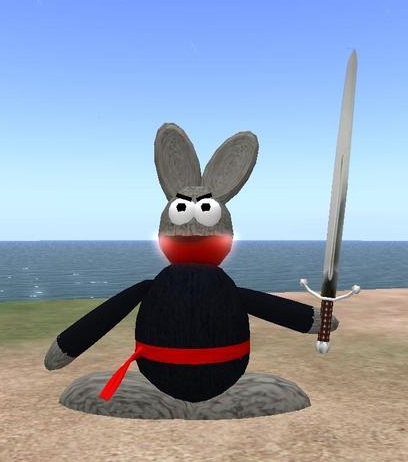
Ninja Bunny, one of the examples of the pets created by Judy Robertson's class.

As students, even when we come to education wanting to learn, and therefore are supposedly mentally prepared to take new ideas on board, we all have a tendency to balk at new and unexplored things, whether that be the course material or the tools that we are given to learn with.

But does this always have to be the case? With proper management of expectations and knowledge about our tools and material, can we not reduce the rate of rejection?

“Iggy’s Syllabus: A Student’s Take on Second Life and Education”

Joe Essid’s (Ignatius Onomatopoeia, or Iggy) last round of students benefited greatly from the experiences of the students who came through his classes previously: the most recent students engaged with Second Life rapidly and positively, having had the benefit of one-on-one orientations,  assignments that combined Second Life skill-building tasks with course content, and information about Second Life‘s uses as a creative learning platform. The earlier students were provided with far less in the way of introductions to Second Life; they were prone to wonder what the point of learning with Second Life was, and tended to finding it boring.

Back in August of this year, AJ Tan, a Cornell student working for Metanomics over his summer break, published his opinions about Second Life, and why he found it boring. The upshot of his argument seems to be that he wants to be entertained and led, perhaps even pushed, at all times and under all circumstances. He does not expect to have to ‘make his own fun’. “I do not wish to go out and find something to do, I have to do enough searching in the real world. I want to be entertained. Virtual worlds are supposed to be an escape from reality – Second Life is too close a parallel to the real thing.”

Educators will be relieved to know that while there are plenty of students out there with opinions similar to or the same as this, it’s not the only opinion out there. Generation Y may require a little coaxing, but Second Life can allow enriching and interesting learning experiences for them, if only they are taught to give it a chance.

One of Essid’s students, Bridget K,  wrote a piece in her writing journal about the educational uses of Second Life, with a decidedly positive bent. It is apparent that she was inducted effectively in the uses of Second Life, and has found the experience beneficial and engaging. All this, despite having acknowledged that her generation “sees education as ‘ineffective, irrelevant, and unproductive’ (Houck).”

Bridget notes that “Second Life provides a unique educational setting for students.  Learners become immersed in their own education and in the environment he or she is in (“National Education Technology Plan”). Second Life provides the educational tool of role-playing.” From the way this reads, she has found plenty of ‘fun’ experiences within digital environments, along with educational value.

Additionally, Bridget notes that “Second Life will benefit our educational system if used correctly.  There should be a balance between real world educational tools and virtual world educational tools,” which sounds completely reasonable. At the end of the day, Second Life is a tool that can assist us in living our lives, but is not something that should take the place of them. Therefore, it should not take over in an educational setting either.

“The snowmen armies: reflections on teaching first year computer science in Second Life.”

Judy Robertson recounts her tale of teaching using Second Life; specifically, teaching Linden Scripting Language (LSL) to her first year computer science students.

She too has come up against the boredom factor when teaching with Second Life – perhaps more students from gaming backgrounds not used to making their own fun? The class is made up of students of various ages with different academic backgrounds, and yet this attitude seems to pop up a lot. As Iggy found, those first few hours in which a student is exposed to a new idea, a new platform on which to learn, are precious and crucial to that student’s concept of how the idea or platform can be used, and their worth.

When confronted with the notion that Second Life is boring, Judy says, “In my view, this is like being given a big box of plasticine and whining “but there’s nothing to play with”. The point is – you’re meant to make it yourself!” Even more so than in other courses, perhaps – the computer science students are expected to design and implement their own creations in Second Life, so they are using a great deal of the functionality of the digital environment, being required to both build and script.

“It’s a lot of fun for me to teach, and based on the learning logs from last year, a lot of fun for the students to learn with.” Despite complaints of boredom during the term, it seems that students can and do come to appreciate and enjoy Second Life in the long run. Some of the students have found learning LSL to be easier than learning Java, which they are doing in a concurrent course. Judy speculates that this is because more rigour is expected in the design and implementation of Java applications. I speculate that despite the lack of documentation and features, that the scripting community, in addition to the course helpers, also improves the ease with which the language can be learned and used.

Iggy managed his students expectations and experiences; he took his experiences with his first groups, learned what did and didn’t work, and made changes.

It sounds like Judy’s class could have done with a little more management in the first few hours. Due to the excessively large number of students (138!) in the one class, she could not have had one-on-one orientations. However, some of the other methods Iggy used, such as distributing articles about Second Life showing it in a positive light and highlighting its creative potentials for his writing students, could have decreased the number of students complaining about Second Life boredom and vastly improved the overall learning outcomes.

Popularity: 4% [?]

That’s QUT for YAWL in SL

The Smart Services Co-operative Research Centre (CRC) is an Australian initiative designed to improve the service industry in Australia. The CRC partnership exists between 10 major industry players and six Australian universities. Its aim is the creation of research-enabled commercial outcomes for its partners. The current 7-year budget amounts to $120 million, with a grant of $30.8 million from the Federal Department of Innovation, Industry, Science and Research, and an investment of $38 million from the Queensland Government and its local partners (SAP, Suncorp and RACQ). The Queensland University of Technology (QUT) is the largest academic contributor.

YAWL (Yet Another Workflow Language), developed at the QUT, is one of the products that have been worked on as a part of the CRC initiative.

YAWL, “Yet Another Workflow Language”

Familiar with flow charts? Yes? That’s great, but will not help you here. Only a minority of control-flow patterns in workflow can be captured by classical flow charts. Nonetheless, they may be the first things you think of when confronted with a 2D YAWL control flow model – keep in mind that YAWL models are far more complex and sophisticated.

In the late 1990s, there were many workflow management systems around, each supporting a variety of languages. Created for the most part in isolation across industries, they used different concepts, different evaluation strategies, and different syntactic restrictions. It was difficult to compare one system to another – no single system could be used to encompass the full range of workflow possibilities.

The Workflow Patterns Initiative is a joint effort of Eindhoven University of Technology (led by Professor Wil van der Aalst) and QUT(led by Professor Arthur ter Hofstede). It was begun in about 1999. The control-flow perspective is one of several perspectives that can be distinguished in process-aware information systems – it captures aspects such as parallelism, choice and synchronisation. Originally 20 patterns were proposed for this perspective, however the latest iteration contains over 40 patterns. The patterns are language-independent, allowing an objective comparison between approaches to workflow management systems.

YAWL grew out of the Workflow Patterns Initiative.

YAWL’s original purpose was to act as a reference language. YAWL is a concise and precisely defined language that comprehensively supports many of the control-flow patterns.

“YAWL, like any other workflow management system, glues together people and applications in order to support processes as they may occur in businesses. It can offer work to the right people at the right time. Here it is important to understand the main perspectives one can have on a workflow:

1) control-flow perspective: what are the tasks involved and what is their order

2) data perspective: what information is involved and to what workflow components is this information visible

3) resource perspective: how is work distributed to the various participants (e.g. is it done on a pull-based or a push-based basis) and on what basis (e.g. a certain task may only be offered to those that play a certain role).

Workflow management has applications in many different domains.” – Professor Arthur ter Hofstede

YAWL Applications

YAWL4Film is currently being used with success in the Australian Film industry. Other YAWL applications are available for Business Process Management, the healthcare sector, and for product recall.

Dr Ross Brown and his team at QUT have been using YAWL to specify quests within online games – a game specific form of workflow – for some years now.

The YAWL – Second Life connection

“Once I had realised that you could link YAWL to a 3D environment for game control purposes, it became obvious that other areas could benefit if we used a more general environment such as Second Life.  So, this year we utilised Second Life’s service invocation interfaces to allow it to talk to YAWL via a custom service – YAWL has an SOA architecture amenable to the creation of custom services interfaces.  You can see some details about this project on my blog at http://bpmve.blogspot.com/2008/07/yawl-and-second-life-linked.html.  In the example we have the workflow tool controlling an avatar, animating a workflow describing the processes involved in film production.  The thing to note is that the avatar is controlled from outside of SL, it is not scripted within SL at all.” – Dr Ross Brown

YAWL comes with a visual editing tool with which to create workflows. Educational scenarios can effectively be created this way. The CRC project involves the creation of more such tools to allow educators to easily create lesson plans within digital environments like Second Life.

“We can also use YAWL to create virtual, training environments for industries such as health, mining or fire fighting where the actual danger is removed but people can train in a realistic environment.”  – Dr Ross Brown

Via QUT News.

Popularity: 4% [?]

Global Kids’ Curriculum – now Extended!

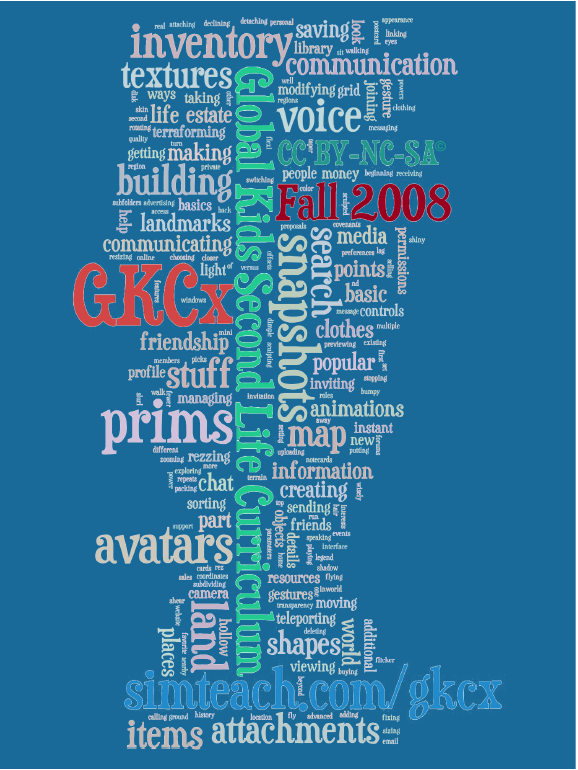
Jeremy Kemp, of SimTeach and Sloodle fame, and Stephen Kemp, have taken the material of the Global Kids’ Curriculum and extended the notion, reformatting the text and images into various forms that improve their usability and use, as well as adding to the already high quality and quantity of notes available.

Global Kids

Global Kids(GK), Inc. created the contents of the Global Kids Curriculum (GKC). GK uses digital media – digital presentations, digital environments such as Second Life and the Teen Second Life Grid, and so on –  to deliver their messages and their programs to the youths and adults that are their targets. GK runs intensive leadership programs for youth, with the intent that kids become “successful students as well as global and community leaders.” The material for adults covers both professional development programs for teachers and educators involved in youth education – multimedia presentations delivered via Second Life – and professional development services, such as RezEd. They also run an innovative high school, and give technological assistance to other schools.

Jeremy Kemp

Jeremy Kemp began his work teaching online in 1999; currently he is an instructional designer at San José State University and a doctoral student, focusing on educational and social issues in immersive environments. The SimTeach Second Life Education wiki that Kemp runs contains a plethora of information for educators entering Second Life and using it as an educational tool. Sloodle is the combination of the  Moodle – a content management system (CMS) – and Second Life that Kemp has created.

Stephen Kemp is Jeremy Kemp’s father.

Global Kids’ Curriculum

The Global Kids’ Second Life Curriculum is a surprisingly comprehensive set of notes, intended to teach the reader what they need to know to use Second Life, as well as being useful for teaching literacy skills. It can be used as a set of handouts or used in its entirety to teach Second Life-specific skills to either students or educators.

The curriculum is composed of nine levels, within which there are modules and then individual lesson plans or “missions” – there are 163 missions.

To download copies of this curriculum, you will need to join RezEd.org and the curriculum group.

The curriculum is on offer for free to all qualified educational institutions, though Global Kids do request donations be made when the material is used, so that they can continue providing and extending their services.

The curriculum was developed by Global Kids Staff and co-produced with Cathy Arreguin.

Global Kids’ Curriculum / Extended

This link points to the Global Kids’ Curriculum / Extended (GKCx) web page, which contains links to the new forms of the  GKC – the new PDF document, the wiki, the Second Life textures, videos explaining the GKCx, and original word documents from Global Kids.

The PDF contains a package of all of the notes contained within a single document. Printed, it makes a handy physical reference. It is also useful as a digital entity, as the Kemps have added a set of bookmarks, a contents page and abstracts for each level, that enable the user to navigate the material easily.

The textures available in Second Life are images of each of the PDF pages from the large package. Paula Christopher (aka Downtown Bloch) has also made these textures available on the Teen Grid.

The wiki is for the most part a replication of the PDF document and is very close to completion.

GKCx  is licensed under a Creative Commons Attribution-Noncommercial-Share Alike 3.0.

The GKCx is an easily navigable and highly useful set of resources that nicely extends the work done by Global Kids. It’s recommended that educators make use of the new formats.

Popularity: 3% [?]

AFTRS: directing the future

Gary Hayes has amazing talent. As with so many people who are masterful in their field, he can make the difficult look effortless. However, this time it’s not an attractive and engaging machinima or build that has me excited, but Gary’s words about the new diploma courses being run at AFTRS.

Forget the glitz and glam, ignore the special effects of the promo videos if you are able. Look, feel and presentation are required elements of film, animation, games and virtual worlds. Nonetheless, the promo video for these courses overshadows something that I feel is of far greater importance: these one year graduate diplomas in Games Design (Directing) and Virtual Worlds (Directing) have great technical depth.  Each has been rigorously designed, will be delivered with the intensity and creativity of amazing mentors, and behind each stands a wealth of knowledge concerning both presentation and mechanics.

The new courses will build upon the work performed within the Animation (Directing) course and the LAMP (Laboratory for Advanced Media Production) initiative.

What does ‘directing’ refer to?

The directing portion of the course titles refers to the fact that participants will be taught, in addition to the technical and business aspects, creative leadership skills, and the skills of innovation and entrepreneurship. Students will be expected to pioneer new ideas and thoughts, to create games and worlds never seen before, and they will be mentored in these endeavors. Originality, and the ability to push the envelope, are key. Students must be seen to be creating the future, not just contributing their small part to a company or the community. The focus of the courses is innovation: brand-new genres and interactive, film-like spaces – things which rarely even pass go in the risk-adverse computer games industry.

Games Design (Directing)

In the context of this course, a ‘game’ is defined as “authored or artificially constructed play”. Game formats and genres of a multitude of types will be considered in the course, from casual to serious/simulations, from console to online multi-player, from children to adult, and so on through hundreds of sub-categories. New gaming tools, such as emotional AIs, natural generative dialogue and realistic motion will be covered also. Significantly, game theory will be covered in-depth, and will be given as much importance as the creation of dramatic depth and visual intensity. Students will be expected to study and understand such things as gameplay and usability before they are let loose with visual and audio tools.

“We love games that have play and story at their core and not just great graphics or deep sound.” – Gary Hayes.

Here is an indicative list of the types of topics that will be covered:

Games Story, Character Design, Games in Motion, Storytelling Essentials, Game Level Design, Mechanics of Play, Cross-Media Incubator, Designing Story Worlds, Acting for Animators, Directing Voice Performers, Genre Workshop, Innovation and Form, The Business of Games.

Virtual Worlds (Directing)

Students will be learning to construct virtual worlds. Social worlds and MMORPGS will be covered, as will film pre-visualisation tools and CG-animated story worlds. Film/virtual world cross-overs will be covered in depth.

“We will also have lecturers from across the Australian and international metaverse industry involved in Virtual Worlds who understand financing, finding your market and target users and of course insights into the technical deployment of large scale community driven worlds. So from the outset students will understand how decisions made at napkin, sketching or proof of concept stages can have enormous impact further down the production chain. Each course will have several small incubator projects but the final major project spread over 13+ weeks, will include extra help in project managing rapid and complex productions.” – Gary Hayes.

Here is an indicative list of the types of topics that will be covered:

Designing Story Worlds, Virtual Camera, Social Virtual Worlds, Storytelling Essentials, Virtual Life, Cross-Media Incubator, The Avatar and Interface, World Design, Acting for Animators, Genre Workshop, Directing Voice Performers, Innovation and Form, Episodic Storytelling

“Eventually games are going to be designed in the same virtual space as the film will be.” – Peter Giles.

An especially exciting part of the two courses is the space in which they overlap. Components of each of the Games Design and Virtual Worlds courses will also focus on film production, the involvement of games and virtual worlds in film production, and the cross-pollination between games, virtual worlds and films.

“What makes these courses unique will be the cross-over with the film craft and directing parts of the school.” – Gary Hayes.

A range of professional associates will be employed during the period of the courses, including Matt Costello (Doom, Pirates of the Caribbean), John Buchanan (ex EA Games Research and Development) and Deborah Todd (author of Games: from BlueSky to GreenLight).

The one caveat I would like to issue about these courses concerns their length – just 32 weeks each. Courses run by the AFTRS are well known for their intense nature, and these will not differ in that manner. If you do join the student body, don’t plan on having any sick days – legitimate or otherwise.

See here for the video promo for the Games Design (Directing) and Virtual Worlds (Directing) diploma courses.

See here for a GameFilmWorld crossover video which Hayes produced to highlight the cross-over between the three.

Popularity: 3% [?]

Superstruct: six weeks to save the world

Superstruct homepage

Play the game. Invent the future.

This is the tag line for the MMO forecasting game Superstruct, an alternative reality game set in the future, developed by a team at The Institute for the Future (IFTF). It’s a SF game, where SF has the original meaning of speculative fiction – crises are speculated upon by the game’s designers, and the objective is to speculate upon solutions to those crises in a collaborative manner.

The game launched on October 6 and will run for only 6 weeks. The IFTF, based in Palo Alto, California, is “an independent nonprofit research group.” Assisting organisations to prepare for the future is a major aspect of the work they do. The game draws on their knowledge and foresight to place crises in front of players, and to judge when players have made substantive leaps forward towards the game’s goals.

Superstruct is billed as “the thinking person’s MMO” – strictly, this means that people who get enjoyment out of thinking will enjoy and appreciate the game (there are no orcs to kill here). Nonetheless, it’s important not to be too off put by this description, because no one player is expected to present complete solutions alone, and because as we now know there’s more to intelligence than scoring high on IQ tests. Within the context of the game, people who are able to collaborate well, to get along well with other people, and to bring teams together, will also fare well.

Su`per`struct´ v. t. 1.To build over or upon another structure; to erect upon a foundation.

Humans have been superstructing for centuries. You could look at it as “standing on the shoulders of giants.” We build upon what our ancestors have done before us. In times of crisis and trouble, humans pull together and launch off from the failures and successes of our predecessors – hopefully this tendency, coupled with the power of our current technologies, will help us survive the super-threats facing us in the near future of Superstruct.

Super-threats

The super-threats are a comprehensive listing of specific crises the world is likely to face in game in the years following 2019.

  • Quarantine covers the global response to declining health and pandemic disease, including the current Respiratory Distress Syndrome (ReDS) crisis.
  • Ravenous focuses on the imminent collapse of the global food system, as well as debates over industrial vs. ecological agricultural models, and basic issues of access, energy, and carbon.
  • Power Struggle tracks the results of energy resource peaks and the shifts in international power as nations fight for energy supremacy and the world searches for alternative energy solutions.
  • Outlaw Planet embodies the volatile mix of new forms of surveillance, transparency, civil rights, and access to information as people work out new rules for human security.
  • Generation Exile follows the massive “diaspora of diasporas” underway globally, as the number of refugees and migrants skyrockets in the face of climate change, economic disruption, and war.

Keeping score

As the game is played out, three things are being tracked: how many people are playing the game, how many “survivability points” have been earned by players, and how many years are left before humans face extinction. The score is a combination of these three items – the higher the score, the longer the human race has left to live on this planet.

“Superstruct is played on forums, blogs, videos, wikis, and other familiar online spaces. We show you the world as it might look in 2019. You show us what it’s like to live there. Bring what you know and who you know, and we’ll all figure out how to make 2019 a world we want to live in.”

Popularity: 2% [?]

Second Life – game?

Second Life - not a game.

Using games in education is a thorny topic. Which games? Which goals? Which outcomes? Which games will warp and twist the minds of our youth, which will contribute to their ongoing development in a positive way?

Games created solely for educational purposes often have their content boiled dry as old bones, all the fun ripped from them in order to create “serious” games. “Fun” in education is often viewed as being suspicious – anything lighthearted or playful is seen as not “serious”. Unfortunately, “serious” has more shades of meaning, that do not involve the concept of fun: serious can mean worthwhile, useful, functional and important – while not excluding fun.

One of the reasons that Second Life gets knocked back as an educational tool is that it is viewed as a game. Second Life is not a game. Second Life contains games, but is not itself a game. Let us examine the reasoning behind these statements, commencing with this definition of “game” by Roger Caillois, via Wikipedia:

A game must be:

  • fun: the activity is chosen for its light-hearted character
  • separate: it is circumscribed in time and place
  • uncertain: the outcome of the activity is unforeseeable
  • non-productive: participation is not productive
  • governed by rules: the activity has rules that are different from everyday life
  • fictitious: it is accompanied by the awareness of a different reality

Fun

Second Life contains fun much as it contains games. In the atomic world, fun exists, as does seriousness (for all meanings of the word) – this is also true of digital environments. Digital environments are not fun all the time. However, playfulness and fun are well-supported by digital environments – they lend themselves to lighthearted interaction and creativity more easily than the atomic environment does.

Separate

A game of chess has a finite starting and ending point, It exists in a “game space”, whether that be the physical location, of the game board and pieces, or a mental space in which the player thinks about the game. Second Life does not have a definite beginning or ending, in which people can “play” it. Second Life is continuous – it exists regardless of whether any given user is in the space or not.

Uncertain

An activity that has a guaranteed outcome is not a game. However, an activity that has some degree of uncertainty is not automatically a game. For the most part, it’s about the degree of uncertainty – something that is more uncertain is more likely to be a game. For most non-game activities in Second Life, the degree of uncertainty is similar to that of non-game activities in the atomic world.

Non-productive

pro·duc·tive (pr-dktv, pr-)

adj.

4. Economics Of or involved in the creation of goods and services to produce wealth or value.

Caillois’ definition of productivity, or lack thereof, revolves around the economic definition of the word. Thus, non-productive carries connotations of not making goods or services, not being directly productive. Similarly, un-productive: adding nothing to exchangeable value. Games are more typically only indirectly productive, adding value through increased knowledge and learning. Second Life is productive, directly and indirectly, in the economic sense of the word.

Governed by rules

The rules in Second Life do not differ from the rules in the atomic world, though there are additional rules that cover circumstances that can occur in digital environments that cannot occur in the atomic world, just as any specialist venue in the atomic world might.

Fictitious

Feigned, rather than artificial. A contrivance, the rules of which only work within the system of the game being played. Second Life is an artificial space, or construct, in which real and meaningful interactions can and do occur. The consequences of actions within Second Life have an impact beyond the digital space.

“If you can tell me how real life isn’t a game, I’ll tell you how SL isn’t one.”

Is the game-like digital interface being used, or the use of avatars, or maybe even the hyperbole and misinformation generated by the press, that causes the confusion? Regardless of the cause, it’s long past time to set people’s minds at ease – Second Life is not a game.

Popularity: 4% [?]